

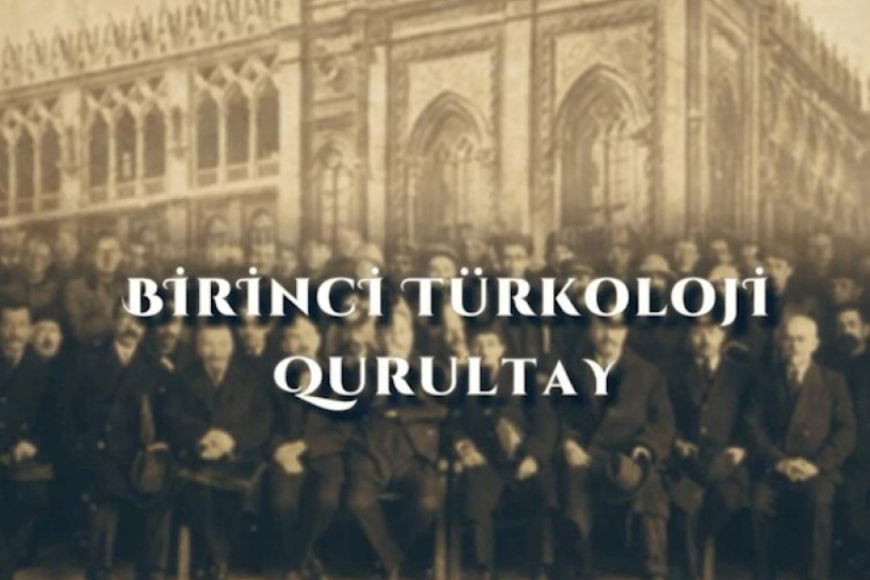
The beginning of the 20th century was a complex yet productive period marked by significant changes in the socio-political and scientific life of the Turkic world. The strengthening of national self-awareness, the expansion of enlightenment movements, and the re-formation of a shared cultural memory created the need for scientific and cultural cooperation among Turkic peoples. It was precisely under such historical conditions that the First Turkological Congress, held in Baku from 26 February to 6 March 1926, became a turning point in the scientific and spiritual history of the Turkic world. Referring to archival documents, N. Mammadli emphasizes that the congress functioned as “the first international constitution of the spiritual and intellectual unity of the Turkic peoples”.
The congress was not an ordinary scientific meeting where only linguistic problems were discussed. Fundamental issues related to the language, alphabet, literature, folklore, history, ethnography and national identity of Turkic peoples were discussed here on a pan-Turkic scale. For this reason, the Baku Turkological Congress is considered the beginning of the formation of Turkological science on an international scale.
One of the main features of the congress was the broad geographical representation of its participants. Nadir Mammadli’s archival research and the facts he cites from the national press of the period, including “Kommunist” and “Bakinskiy rabochiy”, show that Baku held the status of “the intellectual capital of the East” during those days. A total of 131 delegates participated in the congress. The participants represented Azerbaijan, Turkey, Crimea, Tatarstan, Bashkortostan, Kazakhstan, Uzbekistan, Turkmenistan, Yakutia, Chuvashia, Dagestan and other regions. In addition, the participation of Orientalist scholars from Germany and Russia further increased the international scientific prestige of the event.
The congress materials indicate that 38 representatives came from Azerbaijan, 11 from Tatarstan, 8 from Kazakhstan, 7 from Crimea, 5 from Bashkortostan, 5 from Uzbekistan, 4 from Turkmenistan, 3 from Yakutia, 2 from Chuvashia, 2 from Turkey, 5 from the North Caucasus and Dagestan regions, and various numbers of representatives from Russia and Europe.
The statistics showed that Baku had become the scientific and spiritual center of the Turkic world at that time. Although the scholars participating in the congress represented different fields, their common goal was to ensure the scientific and cultural unity of Turkic peoples.
The main scientific direction of the congress consisted of the study of Turkic languages, the issue of a common alphabet and problems of comparative linguistics. Among the scholars who spoke in this field, Professor Bekir Chobanzade held a special place. Bekir Chobanzade delivered a report at the congress on “The Close Kinship of Turkic Dialects”. In the report, the common genetic origin of Turkic languages was explained on the basis of the principles of comparative linguistics. He showed that the differences among Turkic languages had emerged as a result of historical development and defended the possibility of the idea of a common literary language.
His speeches during the congress aroused great interest. Stenographic materials note that participants took extensive notes during Chobanzade’s reports, and long discussions were held after his presentation. In particular, the delegates from Crimea and Kazakhstan followed his views with great attention.
Bekir Chobanzade’s later scientific activity constituted an important stage in the development of Turkological thought. His works such as:
- Introduction to Turkic-Tatar Linguistics;
- Note: the word “madkhal” in the classical text means “introduction”;
- Scientific Grammar;
- Turkish Grammar;
- Scientific Grammar of Azerbaijani Turkic;
are considered fundamental studies in the history of Turkological linguistics. He applied new scientific methods in the fields of phonetics, morphology, dialectology and comparative linguistics. However, in the later period, he was subjected to repression on charges of “Pan-Turkism” and was executed.
One of the enlighteners who spoke at the congress on alphabet reform and national education issues was Ahmad Baitursynov. He emphasized that education in the mother tongue was one of the main conditions for the national development of a people. Baitursynov believed that a common alphabet would serve to strengthen scientific and cultural ties among Turkic peoples. His works:
- Language Tool (Til-qural);
- Alphabet;
- Reading Tool (Oqu quraly);
- Literary Studies or Guide to Literature (Adebiyat tanytqys);
are considered key sources in the history of Kazakh linguistics and enlightenment. He was one of the first scholars to develop the grammatical system of the Kazakh language on scientific grounds.
It is noted in the memoirs of congress participants that Baitursynov spoke very calmly but with deep content, and special attention prevailed in the hall during his speech.
The Russian representative at the congress, Alexander Samoylovich, delivered a report on “The Current State and Immediate Prospects of the Study of Turkic Languages”. He put forward important ideas on the scientific classification of Turkic languages and the study of ancient Turkic written monuments. His works:
- Some Additions to the Classification of Turkic Languages;
- Materials on Turkic Dialectology;
- Turkic Linguistics;
occupy an important place in the history of Turkological linguistics.
During the congress, Samoylovich particularly emphasized that writing Turkic languages in a common alphabet would strengthen scientific relations in the future.
Nikolay Ashmarin, the representative of Chuvashia, spoke at the congress about the position of the Chuvash language within the system of Turkic languages. He noted that Chuvash was one of the important languages preserving ancient Turkic linguistic features. Ashmarin’s works:
- Dictionary of the Chuvash Language;
- Materials for the Study of the Chuvash Language;
- Bulgar-Chuvash Language Relations;
are of great importance for the Chuvash language and general Turkic linguistics.
Another important direction of the congress was the study of the common literary and folkloric heritage of Turkic peoples. Scholars speaking in this direction particularly emphasized the role of folklore and classical literature in preserving national memory.
The representative of Turkey, Mehmet Fuat Köprülü, spoke on “The Development of the Literary Languages of Turkic Peoples”. He studied the historical roots of the common literary traditions of Turkic peoples and showed the important role of folklore in preserving national-cultural memory. His works:
- The First Mystics in Turkish Literature;
- History of Turkish Literature;
- Turkish Minstrel Poets;
- Studies on Azerbaijani Literature;
are considered among the main sources of Turkological science.
His speech during the congress was met with applause several times. Although the translation process took a long time, the participants listened to the report with great interest.
The Azerbaijani representative at the congress, Hanafi Zeynalli, spoke about problems of folklore and folk literature. He noted that folk creativity played an important role in preserving national memory. His works:
- Azerbaijani Proverbs;
- Studies on Koroglu;
- Azerbaijani Folk Literature;
hold an important place in Azerbaijani folklore studies.
Another outstanding Azerbaijani representative of the Turkological Congress was Salman Mumtaz, who spoke at the congress about classical Azerbaijani literature and the preservation of ancient manuscripts. He stated that protecting national literary heritage meant protecting the spiritual existence of a people. His works:
- Sources of Azerbaijani Literature;
- Mirza Shafi Vazeh;
- Khatai Literature;
- Azerbaijani Poets;
are of great importance in Azerbaijani literary studies.
The idea expressed by Salman Mumtaz during the congress — “If the book of a nation is not lost, the nation itself will not be lost either” — was received with great applause by the participants.
The Crimean representative of the congress, Osman Akchokrakli, spoke about Crimean Tatar folklore and ancient written monuments. He emphasized the importance of preserving the common cultural heritage of Turkic peoples. His works:
- Crimean Tatar Songs;
- Old Turkic Inscriptions in Crimea;
- Studies on the History of Crimea;
are of great importance for the study of Crimean Tatar culture.
In the field of history and Oriental studies at the Turkological Congress, the Russian representative Vasily Bartold delivered a speech on “The Current State and Immediate Tasks of Studying the History of Turkic Peoples”. He emphasized that the history of Turkic peoples was an integral part of world civilization. His works:
- Turkestan Down to the Mongol Invasion;
- Twelve Lectures on the History of the Turkic Peoples of Central Asia;
- The History of the Study of the East in Europe and Russia;
are considered fundamental sources of world Oriental studies.
Bartold’s statement that “the history of the Turkic peoples is not only part of the history of the East, but also part of world history” was received with great interest by the congress participants.
The representative of Tatarstan, Gaziz Gubaydullin, spoke about the ethnogenesis and statehood history of Turkic peoples. His works:
- The Tatars and Their Origin;
- History of the Volga Bulgars;
- Materials on Tatar History;
are considered important examples of Tatar historiography.
In the field of enlightenment and terminology, Uzbek enlightener Qazi Alim Yunusov spoke about issues of terminology and scientific language. He emphasized the importance of forming scientific terms in Turkic languages on the basis of common principles. His works:
- Uzbek Terminology;
- Language and Spelling Issues;
- Uzbek Literary Language;
are of great importance in the field of Uzbek linguistics and terminology.
The Crimean representative Hasan Sabri Ayvazov spoke at the congress about the development of enlightenment and cultural ties among Turkic peoples. His works and journalistic writings, such as:
- Language and National Identity;
- Articles on Education and Culture;
- The History of the Crimean Turks;
had a serious influence on the process of national self-awareness among Turkic peoples.
During the congress, Ayvazov often recalled Ismail Bey Gasprinsky’s idea of “Unity in language, thought and action”.
The European Orientalists who participated in the Turkological Congress were the German representatives Theodor Menzel and Karl Müller. Theodor Menzel spoke about the study of Ottoman Turkish and ancient Turkic texts. His works:
- History of Ottoman Literature;
- The Ottoman Language;
- Notes on Turkic Philology or Contributions to Turkic Philology;
are of great importance in the field of Turkic philology.
Karl Müller spoke about the phonetic system of Turkic languages and Altaic languages. His works:
- Turkic Dialects;
- Studies on Altaic Linguistics;
- The Sound Systems of Turkic Languages;
hold an important place in the European school of Turkology.
Thus, the 1926 Baku Turkological Congress was an important stage in the scientific and spiritual history of the Turkic world. The participants of the congress served not only their own peoples, but also the development of Turkological science as a whole. Both the ideas they put forward during the congress and their later scientific activities determined the development directions of Turkological science.
Although many participants later became victims of repression, their scientific legacy remains a fundamental source to this day. The final conclusion reached by N. Mammadli on the basis of archival documents is as follows: “Even when viewed from a distance of 100 years, the Baku Congress remains an unextinguished beacon illuminating the common scientific future of the Turkic world.” The Baku Congress still stands at the center of integration processes today.
Parvin Huseynova
Senior Lecturer at the Department of Humanities,
Doctor of Philosophy in Philology