

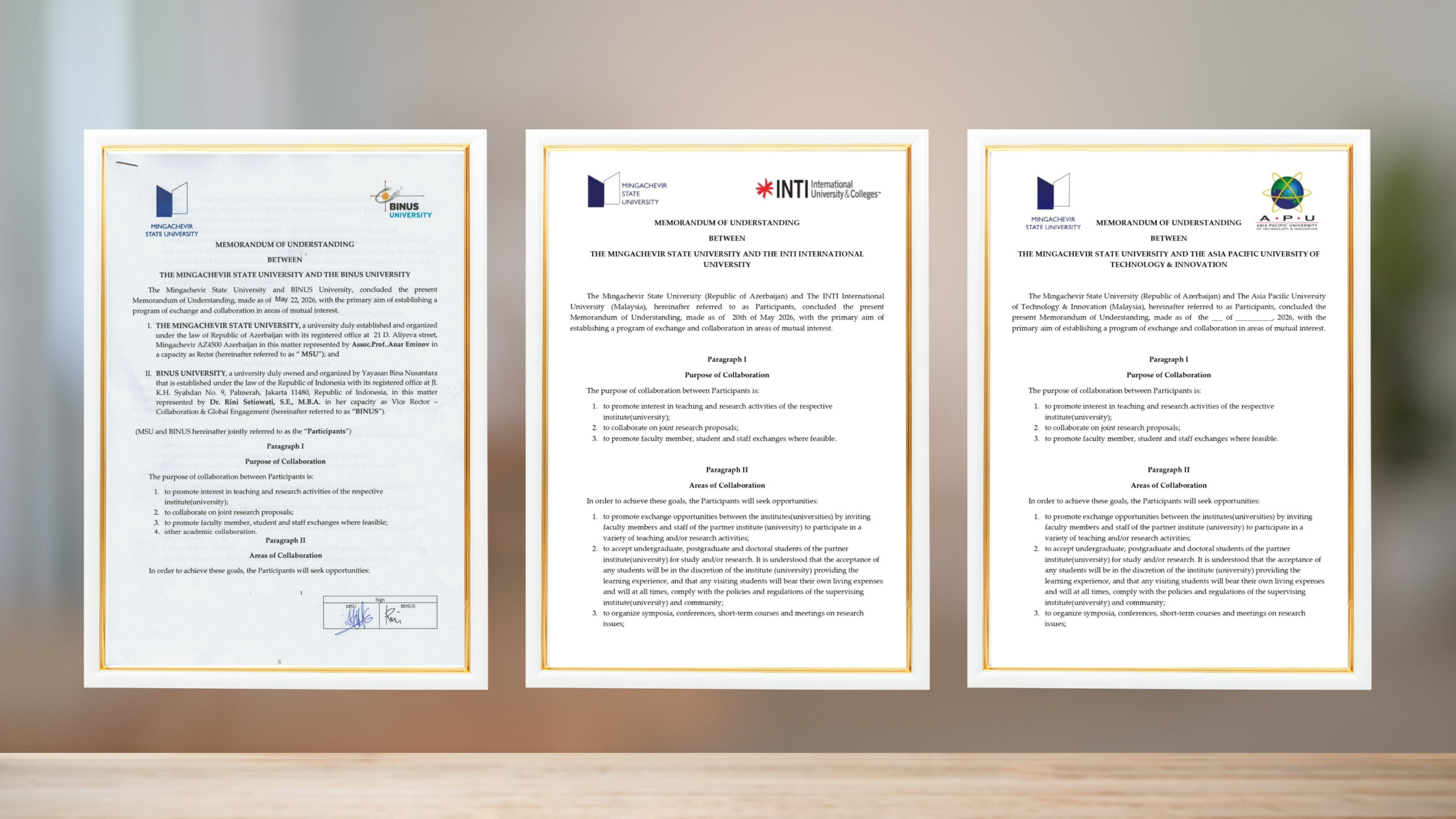
Mingachevir State University (MSU) has recently attracted considerable attention through its active steps toward international academic cooperation. This process is increasingly evolving beyond formal agreements into meaningful and results-oriented partnerships. The cooperation memoranda signed with Indonesia’s BINUS University and Malaysia’s INTI International University and Asia Pacific University of Technology and Innovation demonstrate the consistent and strategic implementation of the university’s internationalization agenda.
As part of official visits to all three universities, the MSU delegation had the opportunity to closely observe modern learning environments, digital education platforms, research laboratories, innovation hubs, and entrepreneurship centers. During the meetings, discussions focused on establishing practical and sustainable cooperation mechanisms, implementing joint initiatives, and building long-term partnerships. Key areas highlighted included the exchange of five students, two academic staff members, and two administrative personnel; the conduct of joint research activities, particularly the organization of international conferences; participation in international grant projects; collaboration in innovation and technology transfer; digital transformation; and academic development. Special emphasis was placed on creating broad opportunities for student participation in semester-long and short-term exchange programs, mutual recognition of academic credits, guest lecturing opportunities for faculty members, and professional development exchanges for administrative staff.
One of the major priorities of the partnership is strengthening the integration of MSU students into the international academic environment. In this regard, it is planned to encourage engineering and technology students to participate in summer schools, short-term academic programs, and student exchange initiatives organized by partner universities in Indonesia and Malaysia. Access to modern laboratories, exposure to innovation ecosystems, and the opportunity to gain international experience are expected to make a significant contribution to students’ professional development.
In addition, the parties discussed prospects for cooperation in organizing international and regional conferences, seminars, summer schools, scientific forums, and collaborative research projects. Particular attention was given to expanding opportunities for joint scientific publications and participation in international research consortia.
The strong positions of the partner universities in international rankings and their active engagement in global academic networks provide additional advantages for MSU. These partnerships can significantly contribute to enhancing the university’s international visibility, attracting international students and faculty members, strengthening research and publication activities, and improving its performance in global university rankings.
Overall, the cooperation established with leading universities in Indonesia and Malaysia is regarded as a new stage in MSU’s internationalization strategy. Beyond accelerating the university’s integration into the global academic community, these partnerships are expected to expand student and staff mobility, increase joint scientific activities, and enhance MSU’s visibility and competitiveness in the international higher education landscape.