

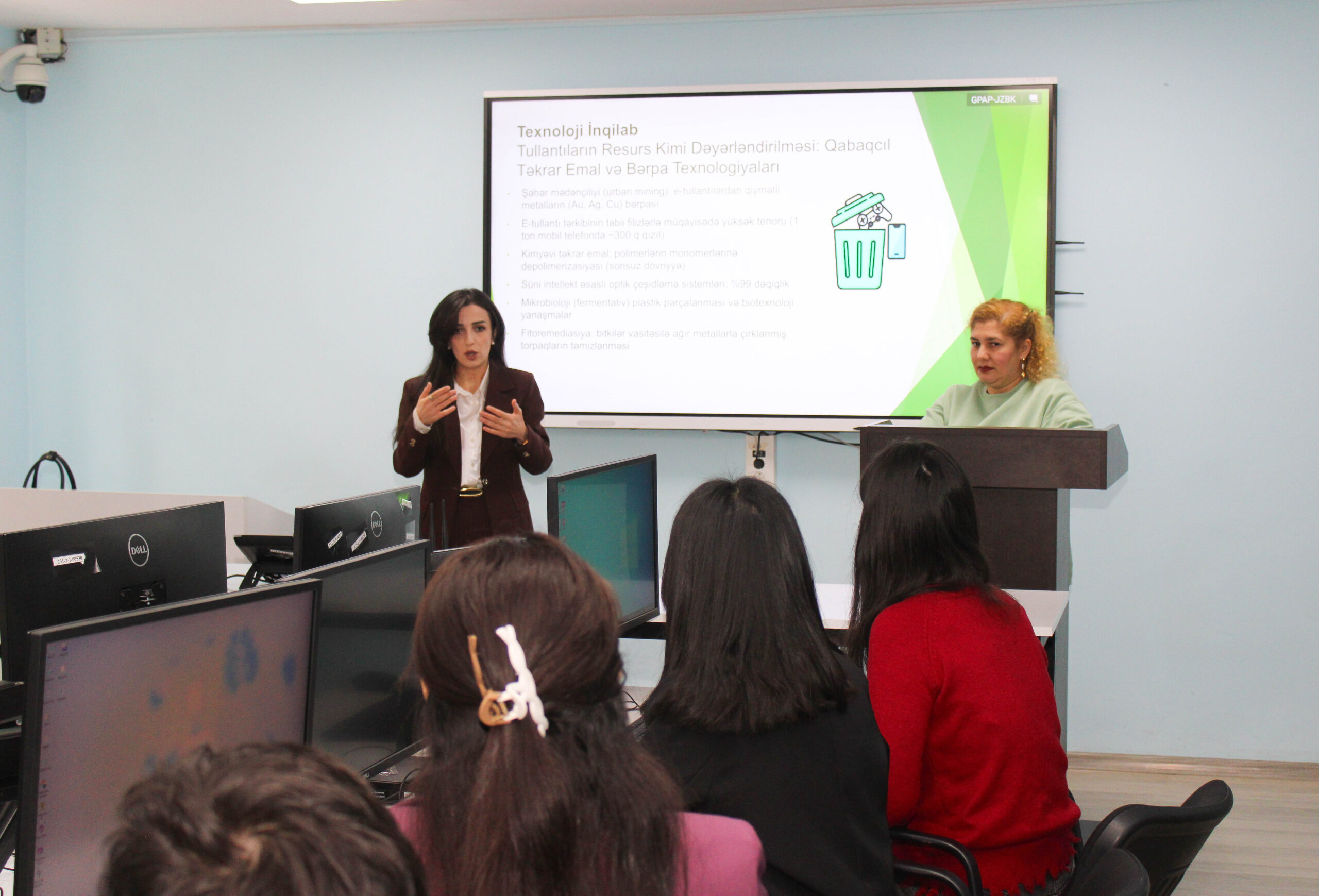


On September 29, 2025, an interactive training titled “Sustainable Management of Industrial Waste” was held at Mingachevir State University for students of Group 24 of the Ecology specialization.
During the training, students were provided with detailed information about the environmental impact of industrial waste, its classification, and the management of hazardous and non-hazardous waste. The key principles of the waste management hierarchy—prevention, reuse, recycling, energy recovery, and disposal—were also thoroughly explained. In addition, students were introduced to modern concepts such as the transition from a linear economy to a circular economy, green production, lean manufacturing, and industrial symbiosis.
Within the framework of the training, global environmental challenges were also discussed. Topics such as the spread of microplastics, PFAS known as “forever chemicals,” recovery of valuable metals from electronic waste (urban mining), waste-to-energy technologies (RDF/SRF), and environmental justice issues were widely examined. Students actively participated in discussions, asking questions and exchanging ideas based on the presented slides and real-life examples.
The training was organized by the Department of Physics and Ecology of Mingachevir State University and was conducted under the moderation of the department’s lecturer Aishan Salmanova.
At the end of the training, participants noted that they had gained valuable knowledge about international practices, advanced technologies, and environmental sustainability principles in the field of sustainable industrial waste management.
It should be noted that such informative and practical trainings organized at Mingachevir State University in the fields of environmental sustainability, environmental protection, and green technologies play an important role in developing students’ professional knowledge and skills, familiarizing them with modern environmental challenges, and promoting sustainable development principles.