


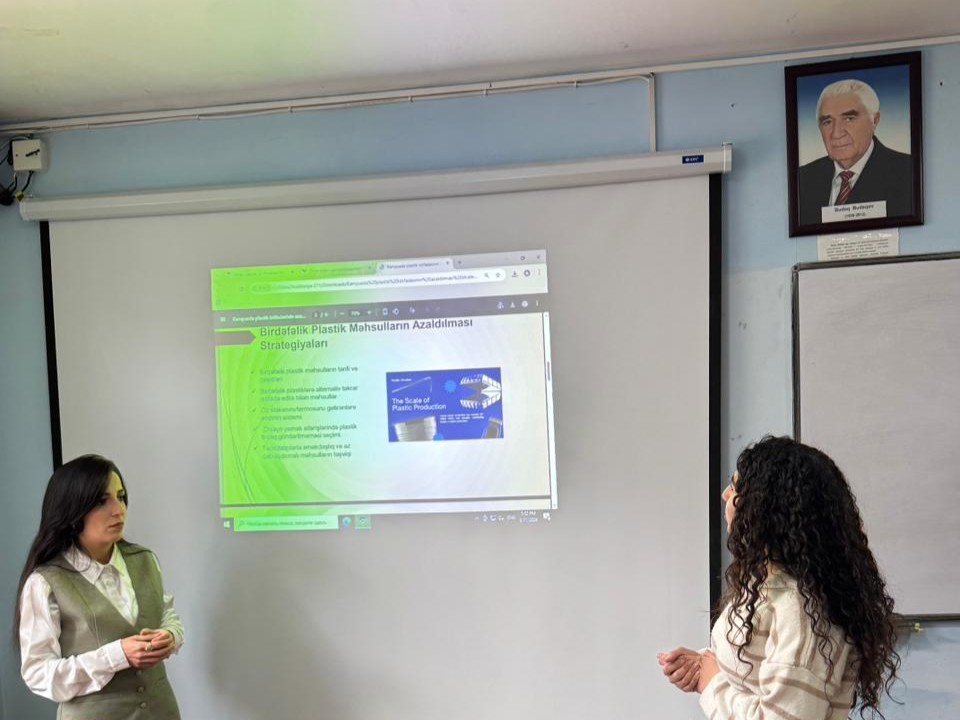
A training session titled “Strategies for Reducing Plastic Use on Campus” was held at Mingachevir State University for students of Group 24 majoring in Environmental Engineering. The training was organized by Ayshen Salmanova, a lecturer at the Department of Physics and Ecology. During the session, students actively engaged in discussions and exchanged ideas on practical solutions to reduce plastic use across the university campus.
Within the framework of the training, detailed analysis was provided on the global growth dynamics of plastic production, the decomposition time of plastic waste in nature, the main sources of plastic use on campus, and the proportion of plastic in campus waste composition. Information was also presented on microplastic pollution and its impact on ecosystems.
The main focus of the training was on strategies to reduce single-use plastic products, promote reusable alternatives, and introduce economic incentive mechanisms. It was emphasized that offering discounts to those who bring their own cups or thermoses, providing options to отказаться from plastic cutlery in online food orders, and collaborating with suppliers to promote low-packaging products are of great importance. Measures such as establishing a network of water dispensers on campus, encouraging the use of steel and glass bottles, and limiting the sale of plastic bottles were also discussed.
During the training, detailed information was provided on reducing plastic bag usage and promoting alternative carrying options. It was noted that since 2021, the use of single-use plastic bags with a thickness of 15 microns or less has been prohibited in Azerbaijan. Discussions also covered implementing paid plastic bags in campus stores and cafeterias, promoting cloth, jute, and paper bags, introducing a “bag bank” system, and using biodegradable bags.
A comprehensive presentation was delivered on reducing plastic packaging and establishing recycling infrastructure. The promotion of bulk purchasing and mass packaging, placement of color-coded collection bins for plastic waste, strategic positioning of recycling containers, and the process of transferring collected plastic to recycling facilities were explained.
At the end of the training, an interactive discussion was held, and participants’ questions were answered. Students Kamil Ismayilzade, Nazli Hashimli, and Jeyran Mahmudova shared their impressions. Kamil Ismayilzade expressed interest in learning about alternatives to single-use plastics, Nazli Hashimli supported the idea of establishing a network of water dispensers on campus, and Jeyran Mahmudova highlighted gaining new knowledge about legislative measures aimed at reducing plastic bag usage. It was noted that reducing plastic use on campus is a shared responsibility that requires the active participation of every student.