

In recent years, there has been a noteworthy reality in the scientific life of our country: success is now measured not by separate initiatives, but by the rise of an entire scientific environment. This development is clearly reflected both in universities and in scientific research institutes.
From this point of view, the recent achievements of Mingachevir State University deserve special attention. Under the leadership of Rector Anar Eminov, the university’s reputation has grown, new projects have been implemented, and important successes have been achieved. Today, MSU is truly experiencing a stage of significant progress.
A similar development can also be observed in the activities of the Institute of Linguistics named after Nasimi of ANAS. During Professor Nadir Mammadli’s tenure as director, scientific dynamism at the institute has increased and important publications have been released. Among them are fundamental studies such as the Dialectological Atlas of the Azerbaijani Language of Karabakh and Eastern Zangezur, the four-volume publication of Mahmud Kashgari’s Divanü Lughat-it-Turk translated by Khalid Said Khojayev, the three-volume Archaic Dictionary of Turkic Words, and finally Professor Nadir Mammadli’s book, published this year, entitled “The First Turkological Congress of 1926: in Historical Context, Archival Documents and the National Press”. All these works are clear indicators of this progress.
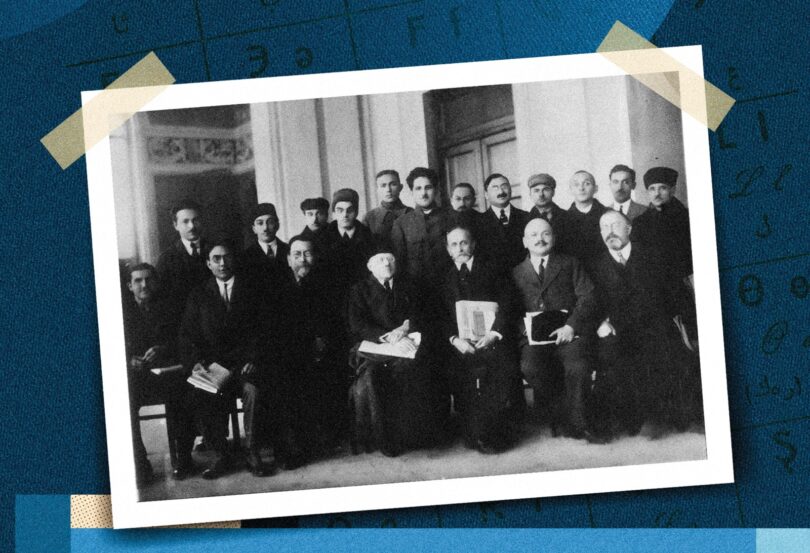
Nadir Mammadli’s book consistently and comprehensively presents the historical significance of the First Turkological Congress of 1926, which is considered an important stage in the development of Turkological thought, based on archival documents and the national press of the period.
Published by the decision of the Scientific Council of the Institute of Linguistics, this 860-page book has Academician Isa Habibbeyli as its scientific consultant, Academician Nizami Jafarov as its scientific editor, and Professor Osman Mert, President of the Turkish Language Association, as its reviewer.
The first page of the book contains the Order of the President of the Republic of Azerbaijan, Ilham Aliyev, dated 22 October 2025, on the celebration of the 100th anniversary of the First Turkological Congress.
This valuable book, published in high quality by the “Elm və təhsil” Publishing House, does not merely acquaint us with history; it restores scientific memory, so to speak.
The scientific novelty of the book includes:
- the systematic re-examination of the First Turkological Congress;
- the re-presentation of documents, facts and participants;
- the restoration of the history of Turkological thought;
- its role as a scientific source for the younger generation.
Professor Nadir Mammadli’s book is a bridge connecting the history of Turkological science with the future.
Why is this book a new achievement and a new contribution to Turkology?
Because in Professor Nadir Mammadli’s book:
- Turkological heritage is brought back to the agenda;
- the sustainable development of national humanities is served;
- scientific memory is restored;
- new research is encouraged.
This work was written not only to recall the past, but also to indicate the direction of future Turkological research.
The author shows that Turkology is not merely an academic field; it is a matter of cultural unity and identity. It is the common scientific heritage, shared cultural memory and common future of the Turkic peoples.
Professor Nadir Mammadli’s book consists of an “Introduction”, three chapters comprising 12 paragraphs, and a bibliography.
In the “Introduction”, the author notes that this book was written to understand the breath of those days, the trembling of the voices in that hall, and the historical weight hidden behind every idea voiced from the rostrum. The Baku of 1926 was not only the capital of one country, but also a mirror of the entire Turkic world.
The talented researcher writes that Baku hosted the First Turkological Congress because, from the beginning of the 20th century, the city had distinguished itself by its high level of intellectual life and was recognized as one of the influential centers of world Turkology.
The first chapter of the book is entitled “The First Turkological Congress: in Historical Context”. This chapter consists of six paragraphs: “The Political and Scientific Foundations of the Congress”, “The Alphabet Issue”, “Writing and Orthography Problems”, “The Terminology Issue”, “Issues of Literary Language in Turkic Languages, Including a Common Literary Language”, and “Issues of Teaching Methodology”. It includes the texts of the main reports and speeches, protocols of the issues discussed, and documents of the relevant commissions.
In this chapter, the author’s aim is not only to present events in chronological order, but also to analytically reveal the historical-political content and ideological directions behind them. For example, in the paragraph entitled “The Alphabet Issue”, Professor Nadir Mammadli shows that the Soviet leadership’s promotion of the transition to the Latin script, at first glance, seemed parallel to Turkey’s reform path, but in essence it was based on completely different ideological foundations. For Moscow, the Latin script was a means of distancing Turkic peoples from the Arab-Islamic cultural sphere and creating a stage for a future transition to the Cyrillic alphabet. For Turkey, however, the Latin script was a symbol of modern nation-building and integration with the West.
One of the interesting issues highlighted by the author is the matter of the Second Turkological Congress. He notes that although it was decided at the congress to hold the next meeting in Samarkand, subsequent developments eliminated the necessity of doing so. This was because the alphabet issue had largely been resolved at the First Turkological Congress held in Baku, and important decisions had been made regarding the transition of Turkic peoples to the Latin script. The author evaluates this fact as the gradual loss of relevance of the idea of holding a second congress.
The documents and studies included in Professor Nadir Mammadli’s book make it possible to gain a comprehensive understanding of the socio-political and scientific environment of that period.
The second chapter of the book is entitled “The Turkological Congress in Archival Documents”. This chapter presents the chronological transcription of archival documents, selected translations and commentaries.
Professor Nadir Mammadli has brought forward ideas about the First Turkological Congress that had not been voiced by anyone for 100 years. He discovered confidential documents of great scientific importance for the study of the history of the First All-Union Turkological Congress in the Archive of Socio-Political Documents of the Administrative Department of the President of the Republic of Azerbaijan and worked extensively on these documents.
The author has presented for the first time to the scientific community confidential, strictly confidential and ordinary documents related to the First Turkological Congress, as well as letters, protocols and telegrams concerning the congress, preserved in the archives of our republic.
This section includes telegrams sent to J. Stalin regarding the convening of the First All-Union Turkological Congress, decisions of the Central Committee of the All-Union Communist Party of Bolsheviks on the matter, stenographic reports related to the congress throughout the USSR, speeches delivered at sectional meetings, and other documents concerning the congress. All materials are certified with seals. This proves that the archival documents were officially under the control of party structures in both Moscow and Baku.
Some of the documents bear the note “Burn after reading”. The tireless researcher N. Mammadli discovered the material in question precisely in the folder belonging to the Confidential 6th Department of the Central Committee, the institution to which it had been sent.
The third chapter of the book by Doctor of Philological Sciences, Professor Nadir Mammadli is entitled “The First Turkological Congress in the National Press”. This chapter consists of five paragraphs: “In Information Sources”, “Yeni yol Newspaper”, “Bakinskiy raboçiy”, “Kommunist Newspaper”, and “Yeni fikir Newspaper”.
The author notes that newspaper and journal editorial offices of that period worked hard to convey the agenda of the congress to readers and carefully covered the essence of the reports and the views of the speakers.
In the third chapter of the book, Nadir Mammadli writes that although studies had been conducted, books and articles had been written, and conferences had been held on the congress from time to time, the activity of the Azerbaijani press in relation to this historical meeting had not been sufficiently researched.
At the end of the book, a rich bibliography is provided. The researcher made use of valuable archival materials and scientific literature written in Azerbaijani, Turkish and Russian, and, as mentioned above, brought forward ideas that had not been expressed by anyone for one hundred years.
It can be stated without hesitation that the publication of this book is not only a scientific event, but also another achievement of the Azerbaijani school of Turkology and a new contribution to Turkology.
We sincerely congratulate Professor Nadir Mammadli and believe that this work will have a long-lasting place in Turkological science.
Namaz Manafov
Associate Professor of the Department of Humanities,
Mingachevir State University,
Doctor of Philosophy in Philology