


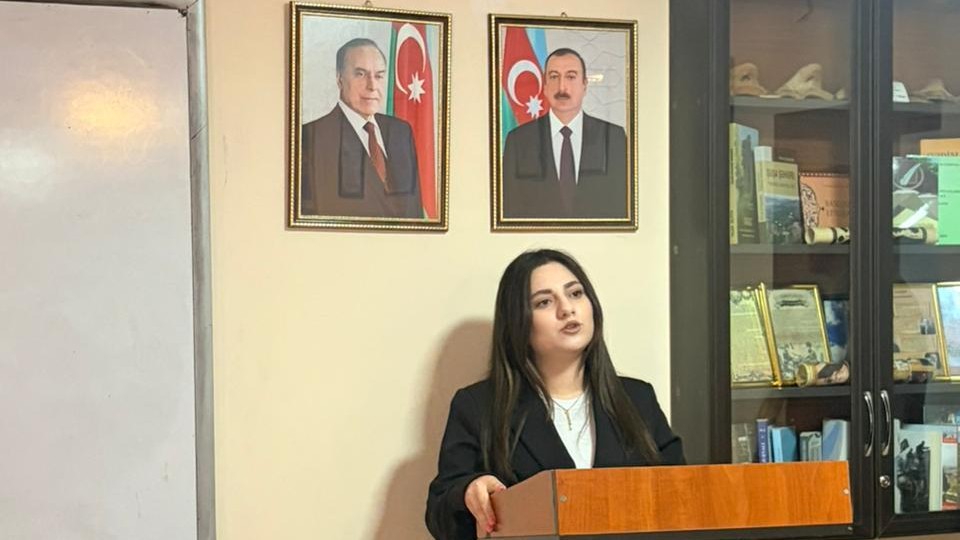

On March 10, 2026, a round table entitled “Realities of Western Azerbaijan: Historical Facts and Modern Challenges” was organized at Mingachevir State University. The event was held in the university’s History Room.
The main purpose of the round table was to scientifically examine the historical realities of Western Azerbaijan, highlight the deportation of Azerbaijanis from these territories, and discuss existing modern challenges related to the issue.
Opening the event with an introductory speech, the Head of the Department of Humanities, Associate Professor Esmira Jafarova, emphasized that the issue of Western Azerbaijan remains relevant both historically and politically. She noted that the deportation of Azerbaijanis from their native lands and the restoration of their rights continue to maintain significance today and should be extensively studied from a scientific perspective.
Afterwards, presentations by student researchers were delivered. The reports broadly analyzed important topics such as the ancient and medieval history of Western Azerbaijan, the resettlement policy of Tsarist Russia, the events of the early twentieth century, the deportations of 1948–1953, the alteration of historical toponyms, the fate of cultural heritage, and the forced displacement of Azerbaijanis at the end of the twentieth century.
At the same time, particular attention was paid to the examination of the Western Azerbaijan issue within the context of international law, the political and legal nature of deportation and ethnic cleansing policies, as well as the assessment of Azerbaijanis’ right of return based on international practice.
During the discussions held around the presentations, participants exchanged views on the topic and voiced various scientific approaches and proposals.
It was also noted within the framework of the event that the statements made by the President of the Republic of Azerbaijan, Ilham Aliyev, regarding the right of Western Azerbaijanis to return to their native lands were brought to attention.
In conclusion, it was emphasized that organizing such scientific events is of great importance in terms of shaping the historical memory of young people, strengthening national identity awareness, and discussing current issues within a scientific framework.