

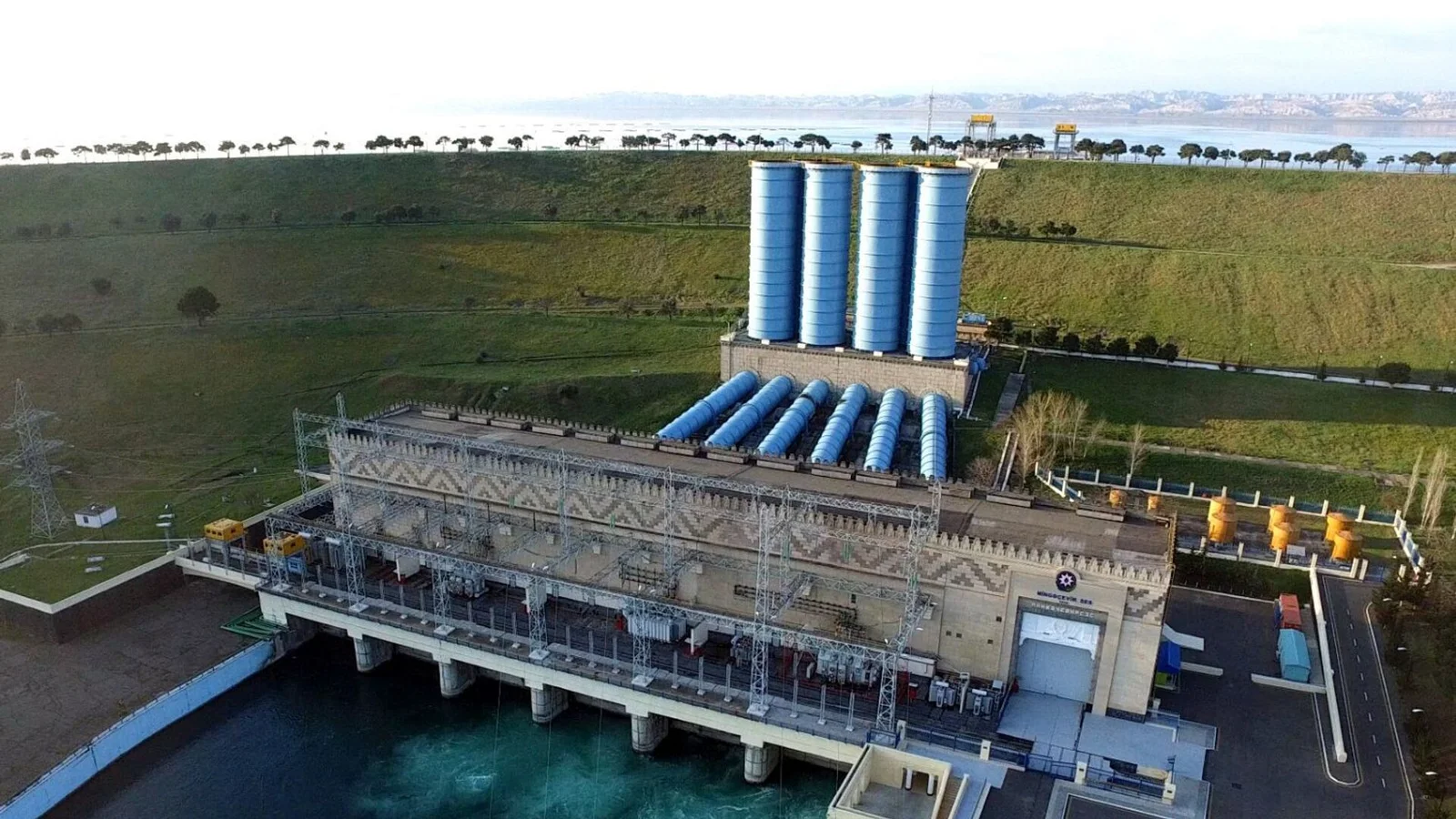
The modern stage of Azerbaijan’s urbanisation history is a highly complex and multifaceted process. Within this process, the development of hydropower infrastructure occupies a special place as one of the key factors in the spatial organisation of economic activity, industrial development, and the formation of new urban centres. From this perspective, the historical experience of the city of Mingachevir is of particular interest. Mingachevir is one of the rare examples demonstrating that a large-scale hydraulic engineering project—the Mingachevir Hydroelectric Power Plant—was capable not only of transforming the natural landscape by altering the course of the Kura River, but also of creating a new model of settlement, defining the direction of the economic modernisation of an entire region, and exerting a significant influence on the socio-cultural development of the state.
Mingachevir is regarded as one of Azerbaijan’s most important industrial and energy centres. Its formation as a modern city is directly linked to the construction of the largest hydropower complex in the South Caucasus—the Mingachevir Hydroelectric Power Plant—and the creation of the Mingachevir Reservoir on the Kura River. However, the history of the city should not be regarded as the result of the natural economic development and urbanisation of an existing settlement. Rather, it should be assessed as the outcome of a large-scale state infrastructure programme aimed at addressing energy, agricultural, transport, and socio-economic challenges.
It should be noted that the territory of modern Mingachevir has a rich historical past. Archaeological research confirms the existence of settlements in this area dating from antiquity and representing various historical periods.
Researchers estimate the age of Mingachevir at approximately 4,000 years. According to them, the history of Mingachevir extends from the Chalcolithic period, dating back to the third millennium BCE, through to the seventeenth century CE.
The renowned Azerbaijani historian, scholar, journalist, and publicist Alisafa Mammadov also put forward views regarding the ancient history of Mingachevir, referring to a number of academic sources. Several sources state that Mingachevir is 4,000 years old. Drawing on historians’ opinions, Alisafa Mammadov extends this estimate and argues that the city is more than 4,500 years old. Saleh Gaziyev and Rahim Vahidov demonstrated that the earliest written monuments bearing the Caucasian Albanian alphabet, which they themselves discovered, were found in Mingachevir. This inscription is currently preserved at the National Museum of History of Azerbaijan.
Boris Aleksandrovich Kantor, one of the first geologists to begin geological exploration in Mingachevir, an author of the project, and a recognised specialist in geological exploration in the Republic of Azerbaijan, wrote in his memoirs:
“I first heard the word Mingachevir from one of the famous professors who lectured us. It was in 1924–1925. The professor was speaking about how Vladimir Ilyich Lenin’s GOELRO plan was being implemented in the country. During the discussion, he referred to the acute need for electricity in the Transcaucasus. He mentioned one or two small hydroelectric power plants and then stated that construction of a giant hydroelectric power station would soon begin on the Kura River, at a place called Mingachevir.”
Nevertheless, the modern history of the city began specifically with the implementation of the project to construct a hydropower complex on the Kura River. The idea of creating a major hydraulic engineering complex emerged during the first half of the twentieth century. It arose from the need to comprehensively regulate the water resources of the Kura River, Azerbaijan’s largest river, prevent destructive floods, and meet the economy’s growing demand for electricity. Although design and research work began in the 1930s, the outbreak of the Second World War suspended implementation of the project. Only after the war ended did the state return to the strategically important issue of constructing the hydropower complex. Pursuant to Resolution No. 1876 of 29 April 1941, adopted by the Council of People’s Commissars of the Azerbaijan SSR and the Central Committee of the Communist Party of Azerbaijan, the Mingachevir Hydropower Complex Survey, Design, and Construction Directorate of “Mingachevirstroy” was established. Construction work was postponed due to the outbreak of the Great Patriotic War. In July 1945, the Council of People’s Commissars of the USSR adopted a resolution on resuming construction of the Mingachevir hydropower complex. This was followed by the large-scale mobilisation of labour resources, engineering and technical specialists, and construction organisations. This period may therefore be regarded as the initial stage in the formation of modern Mingachevir as an industrial city.
The rapid growth of the population resulting from the construction of the Mingachevir Hydroelectric Power Plant also made it necessary to establish a fully developed urban settlement. In this regard, one of the most significant historical events was the official granting of city status to the settlement on 11 November 1948 and its designation as “Mingachevir.” This event holds a special place in the city’s history, as it marked the beginning of the formation of an urban environment encompassing residential neighbourhoods, a transport network, educational institutions, healthcare facilities, and cultural infrastructure.
The construction of the Mingachevir Hydroelectric Power Plant was one of the largest engineering projects implemented in the South Caucasus during the post-war period. The construction of the hydropower complex involved extensive earthworks, the building of the dam and power-generating facilities, and the creation of the largest artificial body of water in the region. The full completion of the Mingachevir hydropower complex and hydroelectric power plant, with a projected capacity of 300,000 kilowatts, was initially planned for 1952, while the first stage, with a capacity of 150,000 kilowatts, was expected to be completed in 1950. However, for objective reasons, the plant was commissioned at full capacity in 1954.
Following the completion of the first stage of the major construction works, Mingachevir received a higher administrative status on 4 February 1954 and was designated a city under direct republican jurisdiction. In the same year, the Mingachevir Hydroelectric Power Plant entered full industrial operation as a strategic facility and became the largest hydroelectric installation in the South Caucasus, laying the foundation for the long-term development of Azerbaijan’s energy system.
The creation of the Mingachevir Reservoir was an equally important development. The process of filling the reservoir took place between 1953 and 1959. Its water surface area reached approximately 605 square kilometres, while its total water volume exceeded 16 billion cubic metres. As a result, the Mingachevir Reservoir became the largest artificial reservoir in Azerbaijan and one of the largest hydraulic engineering facilities in the South Caucasus as a whole.
The significance of the Mingachevir Reservoir is not limited to electricity generation. Its creation enabled the long-term regulation of the Kura River’s flow, significantly reduced flood risks in the lower reaches of the river, improved the water supply of settlements, and created the foundation for the extensive development of irrigated agriculture. The Mingachevir Reservoir also ensured the development of the Upper Karabakh and Upper Shirvan canals and supplied water to vast agricultural areas of the country.
From the perspective of urbanisation theory, Mingachevir is a classic example of an infrastructure-driven city that emerged as a result of the implementation of a major state project. The formation of the urban environment proceeded in parallel with the construction of the hydraulic engineering complex, creating a close connection between energy infrastructure and urban planning policy. The development of new residential areas, engineering and utility networks, various social facilities, and transport infrastructure was directly linked to the requirements of constructing and subsequently operating the hydropower complex.
The social significance of Mingachevir’s hydropower infrastructure was reflected in the creation of thousands of new jobs, the attraction of highly qualified specialists, and the formation of an engineering and technical intelligentsia as well as a skilled industrial workforce. The city became an important educational centre that trained qualified specialists for the energy sector and the industrial complex of the republic. For several decades during the second half of the twentieth century, Mingachevir was one of Azerbaijan’s most highly urbanised cities and stood out for the level of social infrastructure available to its population.
Today, the economic role of the hydraulic engineering complex in Mingachevir is broader in scope. Electricity generation accelerated Azerbaijan’s industrial development and created favourable conditions for the operation of heavy-industry enterprises, the chemical industry, the textile sector, and the agro-industrial complex. Access to electricity became one of the most important factors in modernising the national economy and increasing its competitiveness.
The cultural significance of the Mingachevir hydropower complex also deserves particular attention. The formation of the new city was accompanied by the establishment of theatres, cultural centres, libraries, museums, and educational institutions. As a result, a unique urban socio-cultural environment emerged in which engineering heritage and modern cultural practices were organically integrated. Mingachevir established itself not only as the energy capital of the country but also as one of Azerbaijan’s important cultural centres.
The activities of the National Leader of the Azerbaijani people, Heydar Aliyev, occupy a special place in the development of Mingachevir. During his leadership of the republic, particular attention was paid to the development of the energy complex, industry, and urban infrastructure. His consistent policy aimed at modernising Azerbaijan’s industrial potential further strengthened Mingachevir’s position as one of the country’s largest energy centres. Under Heydar Aliyev’s leadership, numerous socio-economic programmes were implemented to improve urban infrastructure, raise the population’s standard of living, and strengthen production capacity.
At the present stage, President of the Republic of Azerbaijan Ilham Aliyev continues to make significant contributions to the sustainable development of Mingachevir. In recent years, large-scale projects have been implemented in the city to modernise energy infrastructure, reconstruct the transport and logistics system, improve public spaces, and establish and renovate educational and healthcare institutions. The President’s particular attention has focused on modernising the existing energy complex, ensuring the technical and environmental safety of the Mingachevir Reservoir, and developing the modern urban environment in accordance with the principles of sustainable development.
Today, Mingachevir is a dynamically developing city. While preserving its strategic importance within Azerbaijan’s energy system, it is also becoming a major centre of development in the fields of innovation, education, tourism, and culture. Energy infrastructure facilities, educational institutions, sports complexes, modern residential neighbourhoods, and public spaces operate successfully throughout the city.
ALMAZ ALIYEVA
Dean of the Faculty of Engineering at Mingachevir State University
PhD in Engineering, Associate Professor