

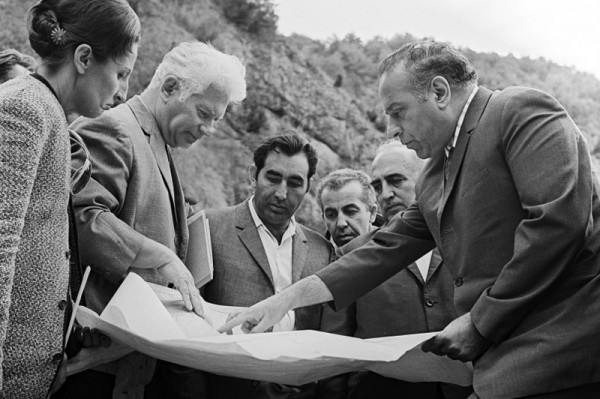
The article discusses Azerbaijan’s path toward energy independence, focusing on the visionary policies and geoeconomic initiatives implemented by the National Leader Heydar Aliyev during this process.
The development of the energy sector in Azerbaijan in the early 20th century was directly linked to the growth of the oil industry. During the Soviet period, Azerbaijan developed its industry and economy within the Union through integrated and chain-like cooperation with other Soviet republics. During the time when the Great Leader, National Leader Heydar Aliyev, held senior positions in Soviet government institutions, numerous industrial enterprises and power plants were built and commissioned in Azerbaijan. In 1974, the foundation of “AzDRES” (currently “Azerbaijan Thermal Power Plant”) was laid in Mingachevir, and with the participation of the Great Leader, the first power unit of the station was commissioned in 1981. Subsequently, one unit was commissioned each year, and by 1988, the eighth unit had been put into operation, allowing the thermal power station—with a capacity of 2400 MW and operating with сверхcritical parameters—to function at full capacity as the largest thermal power plant in the South Caucasus. With the commissioning of this station, Mingachevir became not only Azerbaijan’s but also the South Caucasus’s most important energy center. This was not merely a construction project; it was the deliberate formation of the economic backbone and energy security of a future independent Azerbaijan.
In the early 1990s, Azerbaijan had just regained its independence and was facing serious political and economic difficulties. The energy sector was poorly managed, and there was a severe lack of investment. Under such circumstances, efficient use of the country’s energy resources and access to international markets became critically important.
At the time when Azerbaijan had just restored its independence, the country was on the verge of political and economic collapse. Returning to power in 1993 at the strong insistence of the people, Heydar Aliyev clearly understood that economic independence was the guarantee of political independence. His extraordinary foresight lay in viewing Azerbaijan’s hydrocarbon resources not merely as a source of economic revenue, but as an unshakable geopolitical shield that would protect the country’s state independence.
The historic “Contract of the Century,” signed on September 20, 1994, and the construction of the once seemingly impossible Baku-Tbilisi-Ceyhan oil pipeline brought Azerbaijan’s energy resources to global markets. The signing of the Contract of the Century became a turning point in Azerbaijan’s energy strategy. It attracted the world’s leading oil companies to the Caspian basin and created favorable conditions for substantial foreign investment into the country. This step strengthened Azerbaijan’s international position not only economically, but also politically.
As a result of these initiatives:
- Foreign investment inflows were secured
- The economic interests of major powers were aligned with Azerbaijan’s security interests
- A sustainable financial source was created for rebuilding the national economy and establishing a modern army
- The journey from oil capital to human capital and ultimately to glorious victory began
Oil Strategy and Pipeline Policy
Within the framework of the multifaceted oil strategy implemented by Heydar Aliyev, the main objective was to ensure the secure and diversified transportation of energy resources to global markets.
One of the most significant outcomes of this strategy was the realization of the Baku-Tbilisi-Ceyhan oil pipeline project. By transporting Azerbaijani oil directly to the Mediterranean Sea, this pipeline expanded the country’s energy exports and reduced transit risks. Geoeconomic initiatives and regional cooperation also broadened.
Heydar Aliyev’s policy was not limited to energy production alone. He aimed to transform Azerbaijan into a major regional energy and transport hub. In this regard, the country began actively participating in international projects, and energy diplomacy was strengthened. Azerbaijan became recognized as a reliable partner and started playing an important role in Europe’s energy security.
The outcomes of energy independence can be assessed as follows:
As a result of the National Leader’s visionary policy, Azerbaijan:
- Achieved full control over its energy resources
- Accelerated economic development
- Increased its state budget and foreign currency reserves
- Expanded its influence in regional and global politics
Today, Azerbaijan is not only an energy producer but also a guarantor of energy security.
In conclusion, the energy strategy defined by Heydar Aliyev played a decisive role in strengthening Azerbaijan as an independent state. His visionary decisions and geoeconomic initiatives transformed the country into an important actor on the global energy map.
The strategy and policy founded by Heydar Aliyev were successfully continued and significantly expanded by the Victorious Supreme Commander-in-Chief, President Ilham Aliyev, serving Azerbaijan’s sustainable development. The Southern Gas Corridor, TANAP, and TAP projects turned Azerbaijan into one of the key guarantors of Europe’s energy security.
We should never forget one fact: the economic power Azerbaijan gained in the energy sector was transformed into the strength of our army. The resources obtained from energy independence enabled the country to procure modern weapons independently, build a strong military, and achieve the long-awaited goal of restoring territorial integrity. It was precisely this economic and energy independence that contributed to Azerbaijan’s glorious victory in the 44-Day Patriotic War.
In June 1999, in Baku, at Power Plant No. 1 named after A. Bayramzade—where I was also employed at the time—Heydar Aliyev laid the foundation stone for a new gas-turbine unit. This remains one of the remarkable events in Azerbaijan’s energy history.
Historical Continuity: The “8 November” Thermal Power Plant as the Triumph of Heydar Aliyev’s Ideas
On February 13, 2023, a groundbreaking ceremony was held at the Gulustan Palace in Baku for the construction of a 1300 MW thermal power plant in Mingachevir, known as Azerbaijan’s city of energy specialists.
On June 24, 2025, with the participation of President Ilham Aliyev, the opening ceremony of the station—completed within two years and having a capacity of 1880 MW—took place. This is clear evidence that Heydar Aliyev’s policy has been successfully continued by President Ilham Aliyev. The station was specifically named “8 November,” commemorating the historic date of Azerbaijan’s glorious victory.
Why exactly “8 November”? Because the energy independence policy initiated by Heydar Aliyev ultimately transformed into our victory years later.
Heydar Aliyev’s energy policy played a decisive role in strengthening Azerbaijan’s state independence. As a result of his initiatives, the country gained a strategic position in the global energy system, and sustainable foundations for economic development were established.
This policy continues successfully today and serves Azerbaijan’s sustainable development.
Mahir Ismayilov
Mingachevir State University
Head of the Department of Mechanics, Associate Professor